Tuesday, November 15, 2011

Man or beast? Reading the medieval and Renaissance werewolf through modern forensics

In Bisclavret, her twelfth-century lais, a short, verse medieval romance, Marie de France presents a tale wherein a husband transforms into a werewolf when he sheds his clothes. Bereft of his clothing, Bisclavret has to struggle to reclaim his humanity after his scheming wife hides these one day so she can rid herself of her husband.  Although Bisclavret ends happily and nearly bloodlessly, with Bisclavret’s wife losing her nose when the werewolf bites it off, the medieval and Renaissance werewolf in histories was cruel, lusty, and bloodthirsty. The “real” monster was not the character of a romance, but a very real threat stalking the unsuspecting victim and devouring the corpse. 


Medieval wolf hunt  

Werewolf legends are nearly as old as written history, but alleged cases of werewolfism resurfaced with sharpened teeth and claw in the late-medieval and Renaissance eras.  As early as 1521, Frenchmen Pierre Burgot and Michael Verdun were executed after being accused of being lou-garous.  In 1578, French hermit Gilles Garner confessed to stalking and murdering four children between the ages of 9-12 after a magic ointment turned him into a wolf.  Like Burgot and Verdun before him, Garner was burned at the stake.

Werewolf attacking a man, 16th-century

The case of the werewolf Peter Stubbe of Germany, however, is among the most notorious of the genre.  Executed on October 31, 1589, Stubbe’s story survives in many salacious broadsheets of the age, including a 1590 pamphlet printed in English titled “A True Discourse: Declaring the damnable life and death of one Stubbe, Peeter, a most wicked Sorcerer, who in the likeness of a Woolfe, committed many murders, contributing this devilish practice 25 yeeres, killing and devouring Men, Women, and Children.”  The rapid transmission and translation of this story within a year speaks to strong interest in the lurid details of the Bedburg werewolf. 

Title page of the 1590 pamphlet on Peter Stubbe

Born in Bedburg, near Cologne 1564, Stubbe was “greatly inclined to evil” from a young age, according to the pamphlet.  Stubbe was a wealthy farmer, and the woodcut accompanying the pamphlet (see below) depicts him as a heavyset man.  Many of the details of the case focus upon Stubbe’s extreme sexual deviancy, noting that even prior to his metamorphosis, Stubbe committed incest with his daughter, as “he also lusted most unnaturallye, and cruellye committed most wicked incest with her.”  He also had a mistress, although neither mistress nor daughter nor sex with a close relative could satisfy his urges, leading Stubbe to engage in intercourse with a succubus – a “She-Devil,” as the pamphlet explains.[1] 


Werewolf ravishing a female victim

Stubbe was caught in 1589 by a group of huntsmen who attested that he was mid-transformation.  Facing torture on the rack – where the ankles and wrists are bound in some fashion as the body is slowly stretched out of joint in opposite directions – Stubbe admitted to murdering seventeen young women, children, and men.  Although the accusations include men, the details of the murders all share the distinct feature of the rape of women or girls, where the men are incidental victims or cannibalistic “food.”  If Stubbe spied a group of maidens, “he would be sure to lay hold of one, and after his filthy lust fulfilled, he would murder her presently,” the pamphlet reveals.

Injuries to the women’s bodies suggest the sexual nature of the attacks, as did Stubbe’s own admission that he would tear “children out of wombs.”  Under duress, Stubbe even admitted to killing his own son – the offspring of his incestuous relationship with his daughter – and eating his brains. 

1590 depiction of the torture and execution of Peter Stubbe

After admitting to his crimes, Stubbe faced one of the most gruesome executions on record in Renaissance Europe.  Red-hot pincers were used to tear pieces of his flesh from his body.  His limbs where then broken on the wheel, where he was likely left to suffer in agony while spectators looked on.  The coup de grace would finally come in the form of beheading, and his corpse was burned to ashes.  Sometime during this execution, Stubbe’s mistress and daughter were raped, flayed, and burned at the stake – a tragic footnote since their actions in the case seemed to be an association by guilt or sin, not as accomplices to the werewolf’s murderous reign.  A pole was erected on the execution ground, with Stubbe’s head thrust on the pike at the top. 

Wolf eating corpse, fourteenth-century manuscript illumination

What light can modern forensics shed on cases such as those of Garner and Stubbe?  The stories provide several clues to what may have transpired.  In the case of Garner, a hermit living on the fringes of society, the werewolf may have been living inadvertently on a serial killer’s dumping ground.  The age of all four victims – between 9 and 12 – suggests a murderer with a specific victim group.  If Garner’s testimony can be taken at face value and he is the killer, the surviving evidence, with the emphasis on injuries to the victims’ thighs or legs, also hints at sexual sadism.

In the case of Stubbe, the testimony and evidence strongly suggests a disorganized sexual sadist who drew pleasure in the rape, torture, and murder of his victims.  The accounts of his personal life and insatiable sexual appetite with regard to his daughter, cousin/sister, and mistress buttress this theory.  Even the minor detail about his childhood behavior as being sinister, abnormal, helps to develop an idea about how Stubbe’s deviancy might have begun around the age of sexual maturity since the pamphlets state that he was around eleven when locals began to suspect something was very wrong with the boy. 

Another element of Stubbe’s confession – his account of the murder of his son – can be read with a forensic eye.  Stubbe says he attacked his son and “ate his brains.”  True cannibalism is rare, but it may be that Stubbe is revealing a partial truth – that he bludgeoned his own child in the woods to prevent the evidence of his incestuous union with his daughter from coming to light. 

Gaspar (Kaspar) Puecer, 1525-1602

While many medieval and Renaissance accounts of serial murder insist on demonic possession, pacts with the Devil, or werewolfism, at least one contemporary physician investigating the idea of werewolves understood that the transformation from man to monster was psychological and not physical.  Writing in the mid and late-sixteenth century, Gaspar Puecer, (1525-1602) observed, “Those who are changed suddenly fall to the ground as if seized with epilepsy, and there they lie without life or motion.  Their actual bodies do not move from the spot where they have fallen, nor do their limbs turn to the hairy limbs of a wolf, but the soul or spirit by some fascination quits the inert body and enters the spectrum or ɸάσμα of a wolf, and when they have gutted their foul lupine lusts and cravings, by the Devil’s power, the soul re-enters the former human body, whose members are then energized by the return of life.”[2] (78)  Far ahead of his contemporaries, Puecer understood that this werewolfism was a state of mind, not of body. 

How does a society entrenched in folklore, superstition, and religion define the serial killer?  Today, as in the medieval and Renaissance eras, we label people like these “monsters.”  In our desire to understand the beastly within us, we also seek to differentiate ourselves from what lies beneath. 
 

Renaissance-csi values your input.  Weigh in below in the comments. 


[1] The accounts vary on the relative, with some suggesting a sister or cousin.  The woman’s last name is also Stubbe, and the accusation is clearly that the relationship was deviant. 
[2] See Peucer’s findings in Montague Summers’s The Werewolf (New York: Dover, 2003), pp. 78.  Writing in 1933 Summers has an extensive wealth of materials on werewolves, his conclusions are questionable since Summers himself insists that “Werewolfism is a very terrible and real thing… .”


Monday, October 31, 2011

Medieval and Renaissance vampirism: graves of the past, blood of the present

In 2006, archeologists excavating a mass grave of sixteenth-century plague victims came across a striking skeleton.  Its jaws were pried open, and a brick was inserted into the mouth.  The team insisted they had chanced upon a so-called “deviant burial” – the intentional manipulation of a corpse to punish or to prevent it from engaging in post-mortem haunting.  Intriguingly, this was not the first European skull to have been altered in such a way.  Last week, archaeologists in Ireland revealed their findings: two male skeletons dating to the eighth century who had black stones shoved into their mouths.[1] 


Venetian "vampire" skull, c. 16th century

Both teams extrapolated the obstruction of these skeletons’ mouths as evidence of a form of revenant insurance, preventing these so-called “shroud eaters” or “chewing dead” from causing further death, infection, or destruction to the living and the dead, since it was believed these vampires would initially chew through their own shrouds, then through their digits before moving on to other corpses or the living.[2]  The skeletons are a testament to a pervasive human fear of being consumed by the dead. 


John Collier's Lilith

One of the earliest allusions to human-like creatures who prey upon humans surfaced in Sumerian mythology, in ki-sikil-lil-la-ke, or Lilith, the figure of a female goddess or demon who did not have benign motives when it came to humanity.  Allusions to Lilith in the Old Testament proper surface only once, in Isaiah 34: 13-16, where her name translates to night owl or screech owl:

And thorns shall come up in her palaces, nettles and brambles in the fortresses thereof: and it shall be an habitation of dragons, and a court for owls. The wild beasts of the desert shall also meet with the wild beasts of the island, and the satyr shall cry to his fellow; the screech owl also shall rest there, and find for herself a place of rest. There shall the great owl make her nest, and lay, and hatch, and gather under her shadow: there shall the vultures also be gathered, every one with her mate. Seek ye out of the book of the LORD, and read: no one of these shall fail, none shall want her mate: for my mouth it hath commanded, and his spirit it hath gathered them.”

The Jewish tradition adapted this myth of a female demon in an eighth-century A.D. apocryphal tale of Adam’s first wife, who refused to submit to her husband either domestically and/or sexually and struck out on her own.  Her disobedience cursed her, and when she went on to mate with the angel Samael, she gave birth to demons she could not suckle.  This incarnation of Lilith as succubus, a proto-vampire, developed under what Carl Jung would have called the “collective unconscious,” at the precise moment that the early Irish thrust stones into the mouths of two of their dead. 

Once haunting the medieval mind, the vampire continued to prey on it through the Renaissance.  The Lilith myth expanded, and she was suspected of preying not just upon men and causing nocturnal emissions, but also of causing deaths during pregnancies. 

Max Schreck as Nosferatu, 1922

Though etymology of the word vampire is under some debate, it can at the very least be traced to 1047, appearing as the word “Upir’” in a Russian text.  The hills and mountains of Russia and of Eastern Europe were a breeding ground for tales of medieval and Renaissance vampirism.  The legends of Vlad the Impaler and Erszébet Báthory (1431-76; 1560-1614 – links below) greatly contributed to the vampire mythos, Vlad Dracula inspiring the titular character of Bram Stoker’s novel.[3]


First edition of Dracula, 1897


St. Michan's Church remains

Though printed in the Victorian age, Bram Stoker’s 1897 horror novel is the culmination of centuries of medieval and Renaissance myths about the vampire – particularly the confusion about the natural processes occurring during decay.  Countless books and articles have been written about Stoker’s process and influences, about cholera outbreaks in Dublin, the influence of Vlad Dracula’s history, and the possibility of his childhood exposure to bones semi-interred at a nearby church crypt. 
 
These theories are secondary to what Stoker does present readers with in Dracula: the Victorian continuation of medieval and Renaissance vampire mythos and its relationship with what we today understand from forensic science.  In the novel, Stoker describes the Count’s horrifying crypt, as exposed by Jonathan Harker:


“I knew I must reach the body for the key, so I raised the lid, and laid it back against the wall. And then I saw something which filled my very soul with horror. There lay the Count, but looking as if his youth had been half restored. For the white hair and moustache were changed to dark irongrey. The cheeks were fuller, and the white skin seemed ruby-red underneath. The mouth was redder than ever, for on the lips were gouts of fresh blood, which trickled from the corners of the mouth and ran down over the chin and neck. Even the deep, burning eyes seemed set amongst swollen flesh, for the lids and pouches underneath were bloated. It seemed as if the whole awful creature were simply gorged with blood. He lay like a filthy leech, exhausted with his repletion…” [4]

In a later scene, while Lucy lies on her deathbed after being attacked by Dracula, Stoker writes,

“She was ghastly, chalkily pale. The red seemed to have gone even from her lips and gums, and the bones of her face stood out prominently… There on the bed, seemingly in a swoon, lay poor Lucy, more horribly white and wan-looking than ever. Even the lips were white, and the gums seemed to have shrunken back from the teeth, as we sometimes see in a corpse after a prolonged illness.”[5]

Liver mortis, with coagulated blood pooling

Both scenes are resplendent with descriptions of the natural decomposition process – a process Victorians understood about as well as people living during the Middle Ages.  Stoker’s description of the blood-sated Count as “gorged with blood,” for instance, is a common observation of an exposed “vampire.”  This event, however, is a stage of liver mortis, where coagulating blood tends to settle in areas of the body, making it appear ruddy.  Additionally, the fear that a corpse was feasting on human prey and could appear plump after death is another decomposition process caused by gases excreted by the bacteria aiding in decay. 

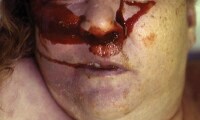
The description of “gouts of fresh blood” along Dracula’s lips was also considered evidence of vampirism in a corpse.  If a vampire were staked, medieval and Renaissance witnesses even testified that fresh blood would ooze from the mouth and nose.  Modern science can explain this post-mortem reaction through blood hydraulics.  Even after death, the body continues to remain active, with bacteria aiding the decomposition process.  As the body decomposes, it becomes more liquefied; the runoff from the orifices is called purge fluid.  An example of this process appears in the image below; please be advised that it is for mature readers:http://img.medscape.com/pi/emed/ckb/pathology/1603817-1607640-1680032-1714502tn.jpg

Stoker’s description does appear to have some connection with notorious diseases of the age, including cholera and tuberculosis (consumption), but the connection of Lucy’s appearance to that of “a corpse after a prolonged illness” is also telling.  Specifically, Lucy’s gums and exposed teeth are identical to many medieval and Renaissance testimonies about the vampire’s “fangs.”  Again, modern forensics helps to dispel the superstition.  As a corpse passes through the liquid stage and begins to desiccate, the lips and gums recede, exposing the teeth.  This stage is fairly prominent in many Victorian death photos. 

Another sign of vampirism – the fresh appearance of a corpse – can be explained only by varying rates of decay.  In colder European climes such as the mountains of Romania, a corpse buried in the winter would essentially be frozen for several months.  Disinterred, it would likely appear to be almost uncorrupted.  This explanation obviously would not rule out every vampire case, but it does help to explain how frozen, infertile soil could breed so many vampires.

Modern pathology studies have attempted to explain vampirism as the result of several diseases, including sexual deviancy (as in the Báthory case), rabies, porphyria, tuberculosis, or pellagra. These theories are largely insufficient since they only describe side effects that mimic vampire behavior, including sensitivity to sunlight or strong smells. What all vampire stories have in common – whether “true” testimonies or Stoker’s tale – is post-mortem descriptions or decay. 


Antoine Weirtz, The Premature Burial

Two other vampire signifiers that so troubled denizens of the medieval ages to the Victorian age were live burials and the absence of a corpse that had clearly been buried.  If a patient in these periods were to go into a coma or suffer from an illness that caused a weak or fluctuating pulse, there were no reliable indicators to show signs of life.  There remained a lingering fear that one might be buried alive.  Victorians were obsessed with this idea – indeed, Edgar Allen Poe set it to type in his “Fall of the House of Usher” – and even developed a bell that was tied to a rope within a coffin, so that a revived person would be able to signal for help.


Bell and coffin device

Especially troubling for men and women of these earlier ages was the missing corpse.  During the medieval era and Renaissance, bodies could not always be buried at the depths of modern ages.  The likelihood of animals digging up a corpse and dragging it away was high.  Likewise, the Victorian age had its own fears of corpses disappearing – or indeed, even being turned into a corpse before one’s time – due to body snatching or “burking.”  Named for William Burke, burking was the intentional compression of a victim until he or she died of suffocation.  Burke and his partner, William Hale, were convicted of seventeen murders-for-the purpose of selling corpses for anatomical research; they were executed in 1829.

The Execution of William Burke, 1829

As recently as 1929, occultist Montague Summers insisted that vampires were real.  This insistence stood in the face of two hundred years of papal denial of the existence of the creatures and stood on the cusp of modern forensics and observation of death, something Europe observed all-too-often in the upheaval of World War I and the Bolshevik revolution.  Although modern science can account for much of what earlier ages observed as vampirism, we remain captivated by the idea of this blood-sucking monster of the night.

Renaissance-csi values your input. Weigh in on the comments section.

Next time: The werewolf of Germany


[2] In the interests of following the scientific method, it should be noted that the female skeleton excavated from a Venetian cemetery holding tens of thousands of skeletons from two plague outbreaks, with 40,000 skeletons from the second outbreak covering her remains.  Though this theory of early modern vampirism has been promoted by the National Geographic channel, I question the hasty assumption that one single skeleton out of tens of thousands was accused of vampirism.  Due to the age of the woman at death – around 70, according to the archeological team – there is a possibility that she was marked not for vampirism, but for spreading disease prior to her death or for being a gossip, since women were punished for such offenses with attacks on their mouths or jaws.  In the case of the two eighth-century Irish skeletons, the case is stronger since the two skeletons buried together have been meted out with the same post-mortem “punishment.”
[4] See Stoker’s Dracula, C. 4
[5] Ibid, C.10


Tuesday, October 25, 2011

There Will be Blood: Erzsébet Bathory’s Depraved World

Investigating the rumors of bodies of mutilated young girls discarded at the church near Castle Csejte, the Reverend Janó Ponikenusz surreptitiously crept through the tunnel connecting his church to the castle.  The year was 1610, and Ponikenusz was replacing the outgoing pastor, who had been documenting the unusually high number of bodies carted from the castle, home of the Hungarian aristocrat Countess Báthory. 


An example of a secret passageway
in Bran Castle, Romania.


As he drew nearer to the castle itself, the pungent smell of human decay began to invade Ponikenusz’s senses.  Following the stench, the reverend discovered boxes containing the corpses of young adolescent girls.  Horrified, he hurried back to his church and penned the following letter: “Oh such terrible deeds…such unheard of cruelties!  In my opinion there had never existed a worse killer under the sun.  But I must not go on, for my heart is bleeding and I cannot speak anymore.”[1]

Although something went awry and the reverend’s letter was intercepted by the Báthory household – an event that must have terrified Ponikenusz since he was in such direct danger of losing his own life – the churchman’s report eventually made its way into the hands of the local authorizes, and then to King Mathias II of Hungary.  The king had ignored previous rumors of strange occurrences at Castle Csejte, but the stories had always involved peasant girls, and in seventeenth-century eastern Europe, there wasn’t much concern for the lower classes. Now, however, aristocratic girls began to disappear into the castle, and their distressed families, augmented by Ponikenusz’s report, forced the king to take notice.[2]


Miniature of Erzsébet Báthory,
The Blood Countess 1560-1614

By the time the investigation and trial ended, the Blood Countess Erzsébet Báthory was implicated in the murder of 80 young girls and women, though the true number could be much higher.  If the numbers are correct, Báthory could be one of the most prolific serial killers in history.[3]  

Báthory was born into a powerful Protestant Hungarian noble family.  She received an exemplary education and “enjoyed dressing up like a boy, studying like a boy, and playing boy’s games, including fencing and horsemanship.”[4]  There are stories that she was troubled from a young age, demonstrating fits of aggression and promiscuity, getting pregnant at age fourteen after a liaison with a peasant boy.  Her pregnancy was covered by a hasty marriage to an aristocrat and war hero, Ferenc Nádasky, in 1575.   By some accounts, her relationship with Nádasky fueled her sadism; in others, he is absolved in the charges leveled against his wife, and it wasn’t until after his death in 1604 that the murders were uncovered.


Báthory family crest

Báthory’s family was also marred by charges of violence and of dabbling in black magic; Báthory seemed to focus on bloodletting, saying at one point that “Thurko [the witch] has taught me a lovely new one.  Catch a black hen and beat it to death with a white cane.  Keep the blood and smear some on your enemy.  If you get no chance to smear it on his body, obtain one of his garments and smear it.”  Numerous cats wandered around her properties, leading to rumors that the animals were her familiars, bewitched to carry out her nefarious deeds.  Several witnesses at the trial said she had a grey “cake” with a communion wafer in the center that she used as a looking glass.

When peasant girls hired as servants disappeared at Csejte castle, the local villagers likely suspected witchcraft.  What the investigative team of December 1610 found was the work of all-too-human sadists.  Palatine (Prime Minister) Thurzó detailed what the unannounced company discovered in the house of horrors: in the entryway, a dead girl who appeared drained of blood.  Not far from the first victim, another girl whose life was ebbing away.  As they walked further into the estate, the men discovered another victim, a dead girl tied to a pillar, likely beaten to death.  In the castle’s prison cells, abused young girls and women cried for help.  Thurzó, a local parliamentarian and distant relative of the countess, could not make sense of what unfolded in front of him.  He would later say of Erzsébet that she was a “wild animal,” “bestial,”  “damned,” “bloody,” “godless,” and “cursed.”


Oldest known portrait of the Blood Countess

Had the Countess only been accused of killing servants, her case would likely have gone unnoticed.  Aristocrats “owned” their servants in the early modern age, and Hungary clung to this feudal system and its laws until 1848.  Báthory’s opening of a gynaeceum, a sort of etiquette school for young aristocratic girls, would be her downfall.

While the countess was confined to a room in her castle, four of her servants – three women and a young man or youth named Ficzko faced trial for their involvement in the torture and death of 80 girls.  Trial documents survived and are the major source of information.  And while Báthory herself would ultimately escape trial and death, her co-conspirators’ and victims’ testimony are a sort of trial in absentia.  Three hundred witnesses gave depositions in front of a panel of twenty-one judges.  The four servants facing charges were tortured to extract confessions.  The transcripts of what transpired at Castle Csejte are shocking, even by modern standards in an age of torture films such as Saw or Hostel.  

According to the testimony, numerous girls were beaten to death.  Some were deliberately exposed to the elements and died from the bitter cold.  Some were starved to death.  Most faced prolonged torture prior to death, included genital mutilation, extraction of pieces of flesh with pliers, removal of eyes or fingers, needles inserted under fingernails.  One body the investigators found at the crime scene had bite marks on the breasts.  One witness escaped and ran back to the village with a knife “still stuck in her foot.”[5]  Another victim displayed her mangled hand and scars where the tormentors had torn flesh from her body.  Accomplice Ilona Jó testified that Báthory “beat and murdered the girls such that it drenched her clothes in blood; she often had to change her shirt after administering such a beating.”[6]

In addition to the testimony, investigators had forensic evidence.  They displayed torture devices during the hearing.  They found articles of clothing identified as belonging to the missing girls.  Bones.  And of course, bodies, including a partially burned body in the castle fireplace.  

The three female accomplices were convicted in the murders, tortured by having their fingers torn from their hands, and burned to death.  Ficzko, perhaps because of his young age or disability, was beheaded before his corpse was burned.  


One of Bathory's letters, in her hand

Báthory’s status spared her life.  Despite King Mathias’s desire that she face trial and execution, the Blood Countess was confined to a small room in Csejte castle, fed through a small slit in the door.  Báthory maintained her innocence, saying that her servants were responsible for the murders, and that she herself was afraid of their actions.  Palatine Thurzó believed that she was mad and ordered that her name never be spoken again in “polite society.”[7]  After four years of solitary confinement, the Countess died, likely in her wedding gown, which she had promised to wear “until my death” in her will.[8]  The local villagers refused to allow her body to be interred in the church cemetery, where so many of her young victims were buried.  Her remains were buried in the family crypt at the castle.

The ruins of Castle Csejte, site of the murders

Where early modern Hungarians were convinced of Báthory’s alignment with the demonic, modern forensic psychology suggests that the Blood Countess and her conspirators were sexual sadists.  Many of the surviving victims testified that they were punished while naked, with much of the torture directed at their breasts and genitals.  Others testified that they were forced to engage in lesbian sex with Erzsébet and punished if they displayed any distaste in the act.  She never injured any young boys, preferring pre-adolescent or young adolescent girls.  Her business venture of a school for young girls would appear to the modern reader to be the mark of a skilled pedophile since it put her in direct contact, unhindered, with her victims.  There was also testimony indicating that she used these torture sessions as a form of release, that “In some cases, she could not contain her murderous rage for even minutes after the conclusion of a stressful event.”[9]  All of these indicate a sexual deviant who gained  gratification out of the torture and abuse of young girls.  

The Countess’s notoriety grew after her death, and several elements contributed to her association with the vampire myth.  Her fascination with the blood of her victims was exaggerated in the eighteenth and nineteenth centuries, with lurid stories surfacing that she drained her victims of blood so she could bathe in it as a beauty treatment for her skin.


Artist Todd McFarlane's conception of
the Blood Countess' notorious blood bath

Several victims testified that when Báthory was ill and confined to bed, she would have girls brought to her and would bite them.  One of her convicted servants said that the cinders used to soak up the blood around her bed was sometimes ineffective because there was so much of it.  And finally, there is the mystery of her remains.  In 1938, there was an attempt to excavate the ruins of Csejte castle.  As in the case of Vlad Dracula, the legendary Romanian proto-vampire, Báthory’s crypt was empty.[10]


Renaissance-csi values your input. Weigh in on the comments section.

Next time: The forensics behind the Renaissance vampire


[1] See Kimberly L. Craft’s Infamous Lady: The True Story of Countess Erzsébet Bathory, 2009: 117.
[2] Although some historians mention the enormous debt Mathias owed the Báthory family – a debt the widowed Erzsébet had tried to collect – the sheer amount of witnesses across all class levels and the eyewitness testimony of the prime minister of the investigation indicate that the king’s bias likely did not influence the trial, though his debt was erased when she was confined to Csejte.
[3] It is difficult to find accurate records of murder in the early modern period.  Lack of an FBI or centralized police system make modern reconstruction of such events difficult, especially when testimony of the period tends toward exaggeration.  One persistent rumor in the Blood Countess myth involves a missing journal of hers that allegedly details some 650 victims.  Since we don’t have access to this diary, we can only turn to the court records.  
[4] See The Private Letters of Elizabeth Bathory. Ed. Craft, Kimberly, 2011: 3.  
[5] See Infamous Lady, 111.  
[6] Ibid, 82.
[7] Ibid, 9.
[8] See Letters, 103.  
[9] See Infamous Lady, 126.
[10] You can read about Vlad’s case at http://medieval-csi.blogspot.com/2011/10/i-am-master-vlad-impaler-and-medieval.html